
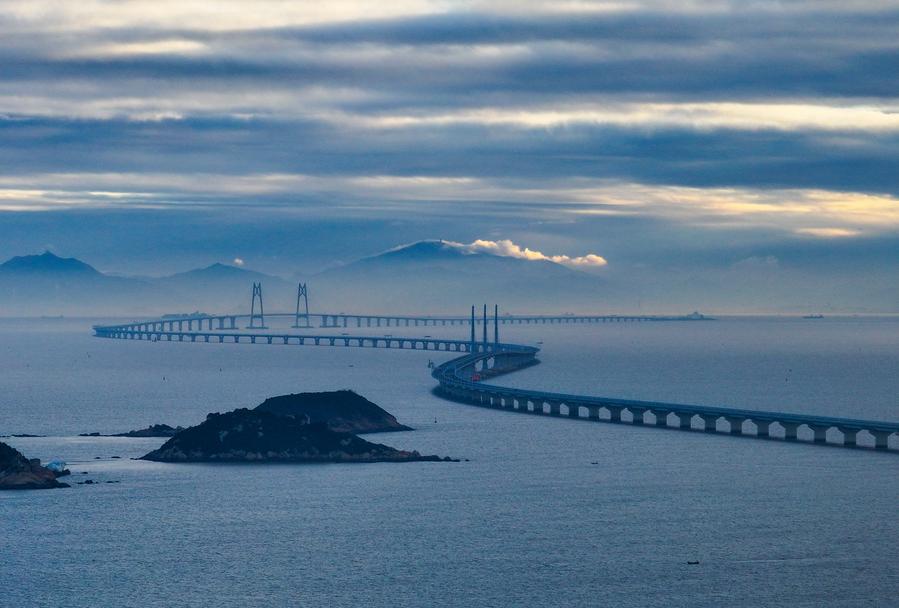
This aerial photo taken on Dec. 15, 2023 shows the Hong Kong-Zhuhai-Macao Bridge in south China. (Xinhua/Liu Dawei)
The Guangdong-Hong Kong-Macao Greater Bay Area (GBA) is being closely-knit by a growingly extensive, interconnected transportation network, poised to become one of China's largest cross-city rail transit systems.
Spanning 56,000 square km with a total economic output of over 14 trillion yuan (around 2 trillion U.S. dollars) in 2023, the area encompasses the Hong Kong and Macao special administrative regions, along with nine cities in south China's Guangdong Province.
Since May, two new intercity rail lines have joined the existing network. Its integrated infrastructure, ticketing, security and information systems allow passengers to travel seamlessly across Guangzhou, Foshan, Dongguan, Zhaoqing and Huizhou in the GBA with a single ticket.
The nine cities of Guangdong in the GBA see an average of over 6 million daily intercity trips. The intercity rail network has greatly streamlined business travel, tourism and commuting.
"Compared to a grueling five-hour drive in the past, my daily commute now takes me just over two hours through the intercity transit network," said a passenger surnamed Xie who works in Guangzhou and lives about 70 km away in Foshan.
"The transit is quick and comfortable. It feels like I'm commuting within a single city," Xie added, noting that the convenience of intercity travel makes it easy to meet and hang out with friends across all five cities.
Experts believe that a bustling, punctual metro system can reduce travel times and transportation costs. Hence, it is logical to develop an extensive cross-city rail transit system to accommodate the high commuter traffic generated by the GBA's integration.
China aims to develop the GBA into a world-class city cluster, a global technology and innovation center, a livable, business-friendly location, an exchange hub for the culture of the East and the West and a world-class tourism destination.
Experts believe that the GBA's integration is crucial for harnessing regional industrial strengths, driving collaborative development, optimizing the industrial landscape and aligning with the global value chain.
According to Hu Gang, a professor at Guangzhou-based Jinan University, the intercity line connecting five cities stimulates vitality and fosters interconnectivity, coordinated development and efficient resource circulation in the area.
With the launch of the Guangzhou-Shenzhen-Hong Kong high-speed railway and the Hong Kong-Zhuhai-Macao Bridge, the GBA's transportation network has fostered new patterns of cross-city consumption, economic exchange and lifestyles.
"On weekends, I often stay in Shenzhen, enjoy dim sum and go shopping before heading back to Hong Kong on Sunday," said Lin Lin, who frequently takes the subway to Shenzhen after finishing work in Hong Kong on Fridays.
Shenzhen and Hong Kong have implemented a mutual authentication system for digital payment in public transport. People can use payment apps including AlipayHK and Alipay for taking buses and subways in both cities, with fares automatically converted at current exchange rates.
"The transportation network fosters regional economic cohesion and job growth, differentiating industries and boostin